LMC Media
Beautiful Breasts Even After Age 45+
May 20, 2026
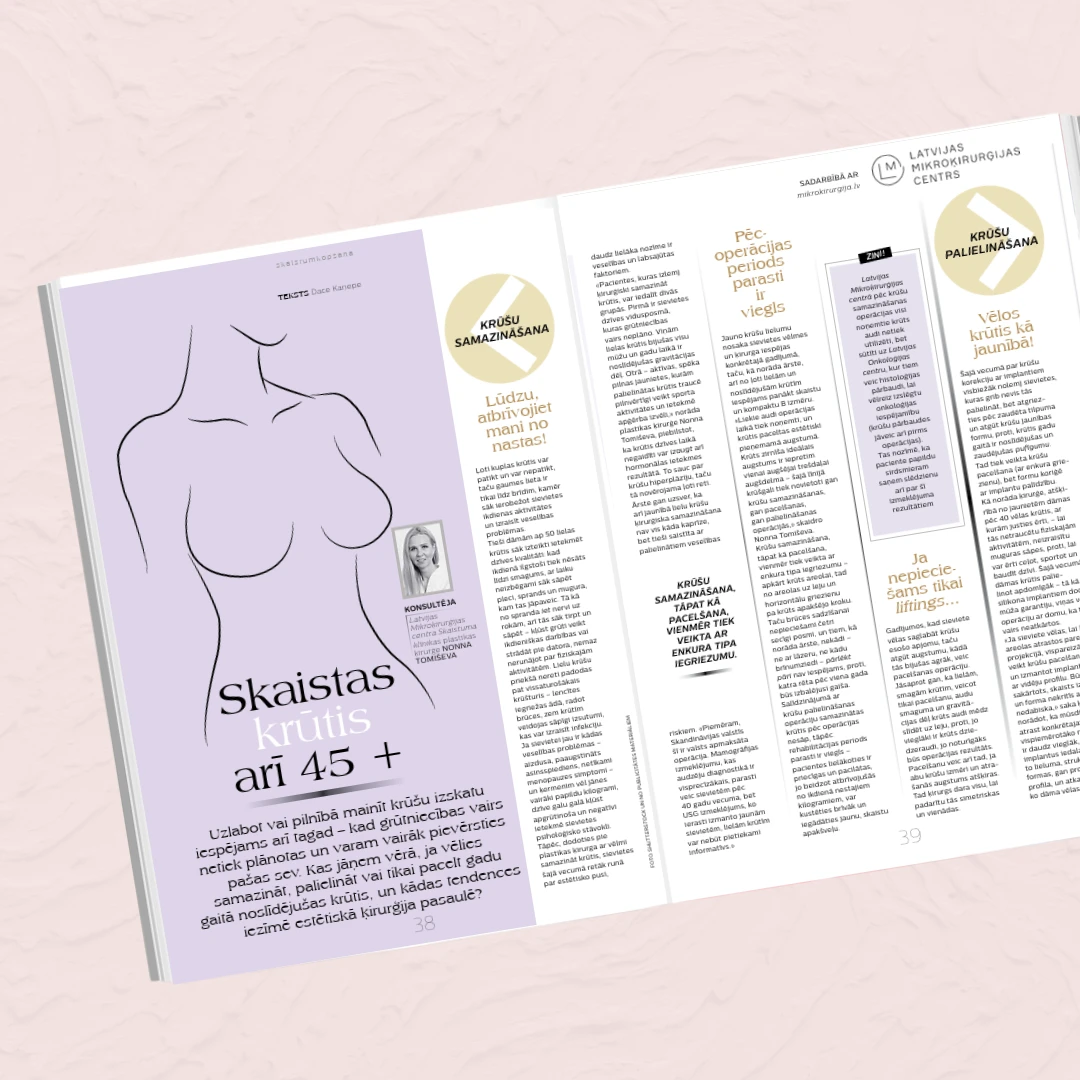


Šo lai izlasa sievietes, kuras uzvarējušas vēzi, bet cīņā zaudējušas vienu vai abas krūtis. Jums jāzina, ka, pateicoties medicīnas attīstībai, ir vairākas metodes, kā uzburt jaunu krūti, un lieliski, ja ķirurgs var izvēlēties tev vispiemērotāko, pašu labāko krūts rekonstrukcijas veidu.
Plastic surgeon KALVIS PASTARS is the physician who, over the past few years, has most persuasively and passionately highlighted the fact that breast reconstructive surgery is an integral, evidence-based component of recovery, and in many countries’ healthcare systems, it is the final stage of breast cancer treatment. Our women, too, deserve modern, state-of-the-art healthcare—just as foreign patients currently receive it when they come for surgery at the Latvian Microsurgery Center, since their governments cover these costs for them.
Who is he?
Plastic surgeon at the Latvian Microsurgery Center for 20 years; specialties: head and neck oncology and reconstructive microsurgery, hand surgery.
He has performed countless breast reconstruction surgeries.
He gained his expertise at Yale University’s Waterbury Hospital in the United States, the Mayo Clinic in Rochester, as well as at the Hand and Reconstructive Microsurgery Center at the National University Hospital in Singapore, where he earned a Doctor of Medical Sciences degree in surgery.
Director of the Latvian Microsurgery Center.
A doctor who CARES. He is actively involved in all efforts to save people’s lives and protect their health, so that they can return to a fulfilling life and work environment. He also works to improve the education and professional development of young doctors.
What's this story even about?!
Breast reconstruction is most appreciated by women who have lived without a breast for some time.
She understands what it's like down to the depths of her heart. All these experiences—psychological, physiological, and social…
Among cancer patients, there are so many wonderful, beautiful, intelligent, and talented women who are doing their very best to cope with the loss of one or both breasts, yet they often feel emotionally and psychologically devastated, their ability to work is diminished, and their family relationships may also suffer…
Some women even have to see a psychotherapist or psychiatrist because they develop depression. These stories, which patients confide to their plastic surgeon, are particularly harrowing precisely because they are so real. Not to mention that, when living with only one breast for a long time, the body’s centers of gravity shift purely due to physiological asymmetry! This leads to poor posture, back pain sets in, the spine becomes deformed, resulting in compression of the nerve roots, changes in the load on the large joints—the hips and knees—as well as the feet, and circulatory disorders… And on top of all that, there are purely practical inconveniences—choosing clothing, wearing a breast prosthesis.
The government provides every woman with this bra insert for two years, but unfortunately, they usually wear out much sooner—so what then?…
Why this long and emotional introduction? For two reasons. First, women who have survived breast cancer should be given the opportunity to continue living a full life, rather than hiding their physical imperfections. And second… Every year, 1,000–1,200 women in Latvia are diagnosed with breast cancer, and about 30 percent are diagnosed at a late stage —partly because the state-funded breast cancer screening program is implemented very poorly here.
Although every two years, every woman aged 50 and older receives a personal invitation to a government-funded breast mammogram, unfortunately, the response rate is low. In 2020, over a nine-month period, only 31.8 percent of the women invited participated in this screening program. And one of the reasons, in my opinion, is that comprehensive breast cancer treatment—which also includes reconstruction of the lost breast—is not provided. Specifically, Latvia has still not reinstated the breast reconstruction program, which was suspended in 2009 due to a major financial crisis. Twelve years have passed! On the other hand, if women knew that after breast cancer treatment the government would help them regain their lost breast, I think that the fear of this disease would be significantly reduced, and this would certainly give women the psychological courage to see a doctor in a timely manner and—more importantly—improve early diagnosis rates.
I am pleased that, through my active involvement with the Latvian Women’s NGO Network, the women’s associations Vita and Dzīvības koks, the charity foundation Rozā vilciens, as well as the Ombudsman’s Office, oncologists, and plastic surgeons, and the breast cancer patients themselves—and thanks to public support, more than 13,000 votes were collected on the manabalss.lv portal calling for the breast reconstruction program to be reinstated. The bill has now been submitted to the government and the Saeima for consideration.
Light at the end of the tunnel?
Yes, it’s possible that this matter will finally move forward, since there is a very high probability—barring yet another major unforeseen event—that the government will allocate funds for the breast reconstruction program so that it can be resumed starting in 2022. In any case, the Ministry of Health, the National Health Service, and the Saeima’s Social and Labor Affairs Committee have promised that the breast reconstruction program will be included in the national budget.
But until that happens…
Currently, it is possible to undergo reconstruction using public funds, but the problem is that the government does not cover the actual costs of the procedure. As a result, hospitals are forced to choose the cheapest reconstruction methods—namely, restoring the lost breast with expanders and implants— but, first of all, this may not be the best method for that particular woman, and a different one may be needed.
Second, yes, the government covers a certain portion of the cost of breast reconstruction, and as proof of this, ministry officials cite figures showing that 73 such surgeries were performed in 2018 and 115 in 2019…. However, a very important detail is being overlooked—the implant used for breast reconstruction must be purchased by the woman herself. One implant costs around 450 euros; two, around a thousand. Plus the copay for the surgery… And what if a woman doesn’t have those funds? So the only conclusion we can draw is that the state currently covers only part of the cost of breast cancer reconstruction surgery, and these procedures are available only to women who can afford the implants. Furthermore, the number of patients who, for medical reasons, are eligible and able to have their lost breast reconstructed in this way is extremely limited.
It therefore follows logically that, for the time being, it is not possible to provide breast cancer treatment in Latvia in accordance with nationally approved guidelines without the involvement of patients’ private funds.
More about the methods
We always recommend that women diagnosed with a malignant tumor consult with a plastic surgeon before undergoing breast cancer surgery. This is standard practice worldwide. It is also very valuable for a plastic surgeon to provide insight into reconstruction options, planning, and approaches. After all, it’s not the case that the same method is used for all women. There are three types of reconstructive surgery, and the choice depends on the extent of the breast cancer surgery and the condition of the surrounding tissue.
FIRST – using expanders and implants
There are two possible strategies here.
The first is that breast reconstruction is performed immediately—during the same surgery in which the breast tissue is removed, an implant is inserted right away. This can be done if there is a sufficient amount of good-quality skin and subcutaneous tissue to completely cover the implant.
Another technique—the same can be done in two stages. First, an expander is inserted. This is a special balloon that is gradually filled with sterile saline solution over time, and in this way, the tissue, skin, and muscles in the breast area are slowly and gradually stretched, giving the breast its shape.
Pēc tam nākamajā operācijā espandera vietā ievieto implantu, kas tur jau paliek pastāvīgi. Implanti ir dažādu veidu un dažādu formu, ķirurgs var izvēlēties piemērotāko, lai sasniegtu vislabāko estētisko rezultātu.
Implant placement is the technically simplest method.
Pros: a short postoperative period, no additional scarring, and, in the event of failure, there is always the option of performing another type of reconstruction—using flaps. However, implants have one drawback—they do not last forever.
Statistics show that about half of patients will still need to have their implants replaced within ten years. Theoretically, there is a possibility that an implant could rupture. Fortunately, the new generation of implants has, so to speak, a “memory,” and gel leakage no longer occurs—even if the implant ruptures, it retains its shape. However, such an implant must undoubtedly be replaced. Sometimes scar tissue thickens, preventing the implant from moving freely. Sometimes the breast sags, or even hurts… The behavior of the implant in the reconstructed breast can be monitored using ultrasound or magnetic resonance imaging.
Quite often, breast reconstruction is deliberately postponed. In other words, a woman first undergoes treatment for breast cancer, and only after the therapy is completed is she allowed to undergo breast reconstruction.
Typically, these are patients who need not only surgery but also chemotherapy and/or radiation therapy to overcome the disease. There are also women who choose to take the safest route themselves, fearing that breast reconstruction might somehow complicate the diagnosis—«What if the doctor misses something, misses it, and some cancer cells remain in the breast…» However, research and our practical experience show that breast reconstruction in no way impairs the detection of breast cancer recurrence. If the disease returns, it does not mean that it is harder to diagnose. That is not the case; it simply requires a slightly different approach to follow-up examinations.
The operating surgeon explains this to each patient individually.
OTRA method – using the patient's own tissue
The most common sites from which tissue flaps are harvested are the chest wall, the anterior abdominal wall, the buttocks, and the inner surface of the thigh. I can say right away that these procedures are longer and more complicated than the insertion of expanders and implants. Although…
Depending on how you look at it, everything is relative.
When performing breast augmentation using a tissue expander and an implant, each surgery lasts about two hours, but two surgeries are required.
On the other hand, when creating a new breast using a flap, if everything goes smoothly, it can be done in a single surgery.
Of course, the postoperative period is more difficult for the patient because the extent of the surgery is much greater. However, from a long-term perspective, all of this effort has its benefits. Breast reconstruction using the patient’s own tissue can provide a more durable, natural-looking result than reconstruction based solely on prosthetic implants.
Ķirurgs var precīzāk pielāgot veselajai krūtij rekonstruējamās krūts formu un izmēru. Tomēr sievietei jāņem vērā, ka ķermenī būs vairāk rētu – gan vietā, kur krūts tiek rekonstruēta, gan tur, kur audi tiek paņemti. Tiesa, šīs rētas ķirurgs parasti veido vietās, kuras ir salīdzinoši maz redzamas un viegli paslēpjamas. Ar laiku rētas kļūst arī bālākas un nav tik uzkrītošas.
Flaps are also used in situations where soft tissue volume needs to be restored. This is most often necessary for patients who have undergone radiation therapy or who have had problems with scar healing following cancer surgery—in such cases, a well-vascularized tissue flap must be placed in the breast area.
The most well-known and popular breast reconstruction technique worldwide and in Latvia involves rotating a myocutaneous flap from the latissimus dorsi muscle onto a vascular pedicle. Myocutaneous means a flap formed from skin and muscle…
So, it is routed through a subcutaneous tunnel in the armpit area to the anterior wall of the chest, on the side of the breast being reconstructed, and used to create the shape of the breast. It’s hard to believe, but surgeries of this type have been performed around the world since 1897, and that means only one thing—that this technology, which has survived to the present day, is sound and has been refined to a very, very high degree.
Breast reconstruction using rotation of the latissimus dorsi muscle is typically performed on slender women.
For those who, either due to pregnancy and childbirth or simply because they have a greater amount of soft tissue in the anterior abdominal wall and a sufficiently thick subcutaneous layer, the tissue flap is taken directly from this area. The flap is either rotated onto a muscle pedicle, or—even better—the muscle is spared; it remains in place, and only the skin and subcutaneous tissue are removed.
By transplanting this tissue onto the anterior wall of the chest cavity, a breast is formed and blood circulation is restored. As a result, the patient not only gains an aesthetically pleasing breast but also a slim, flat abdomen. The scar from the tissue harvest is hidden under underwear.
Although less common, a method involving the removal of tissue from the buttocks is suitable for a specific group of patients. This is particularly useful when both breasts need to be reconstructed and there isn’t enough soft tissue in the anterior abdominal wall. There is a special technique for harvesting the flap and then simply suturing the empty space closed—the skin is quite pliable in this regard. The scar is again hidden under underwear; only the buttocks remain slightly smaller on one side. This year, we performed such a procedure on one woman, and the aesthetic result is very good.
Another site from which tissue can be harvested is the inner surface of the thigh—the skin, along with the subcutaneous tissue and muscle, is transplanted to create a new breast.
Once breast reconstruction is fully complete, a nipple can be created—this is a separate, minor procedure, usually performed no sooner than 3–4 months later, but most likely after six months, once the breast has fully taken shape. After that, areola tattooing can be performed.
If everything is done perfectly, the result is truly beautiful, and someone unfamiliar with the procedure often can't even tell that the breast has been reconstructed.
The only thing that might give this away are the scars. But the patients are also resourceful and creative—they’ll get a cute little rose tattooed right over the scar!
THIRD method – combining a tissue flap with an implant
This is how you can achieve a larger breast size. This method is used when a woman still wants full breasts (or used to have them), but there isn't enough tissue for reconstruction.
We use this method relatively rarely. But there is another nuance… Patients who have breastfed their babies often have sagging breasts, but the reconstructed breast is, of course, shaped as it should be, rather than as it has become after breastfeeding. In such cases, it would also be advisable to perform a correction on the other—healthy—breast. And if a woman has very large breasts and wants to reduce their size—to relieve the strain on her back—that option is also available.
An oncologist or a plastic surgeon—which one?
It just so happens that two types of surgeons may work together on a woman’s breast—an oncologist, who performs the oncological surgery, and a plastic surgeon, who reconstructs the lost breast. As the patients themselves sometimes joke: one is for health, the other for beauty! But in reality, that’s not the case at all—the plastic surgeon is also concerned with health. First, the cancer must be treated—that is the primary goal, and breast reconstruction is the next step. There can be no talk of breast reconstruction if the cancer hasn’t been cured!
For example, we—the doctors at the Microsurgery Center—have a very successful collaboration with specialists at the Latvian Oncology Center. They perform the simplest breast reconstruction surgeries using expanders and implants themselves, but if the oncologists believe that a patient needs our expertise, they call on us for help. As I’ve already mentioned, patients undergoing radiation therapy cannot undergo reconstruction with expanders and implants at all; they require tissue grafting. And this requires close collaboration between oncologic surgeons and plastic surgeons—we must not compete with one another at all! Because the patient certainly won’t benefit if we each try to pull her in our own direction. That wouldn’t be wise.
Right now, we're all on the same page—everyone understands how important it is to reinstate the breast reconstruction program.
When that happens, there will actually be no shortage of work for anyone. Since almost nothing has been done for eleven years, the number of patients who dream of having both breasts again is quite large.
Criteria Used to Evaluate Patients
Cancer stage, metastases, and/or planned radiation therapy and chemotherapy.
Weight, body mass index.
Concomitant conditions (diabetes, vasculitis, cardiovascular and pulmonary diseases).
The quality and amount of remaining tissue in the area where the breast was removed, and the size of the other—healthy—breast.
Available lever donor sites.
The patient's motivation and psychoemotional state.
Smoking. You must quit at least 6–8 weeks before surgery.
Every year in Latvia, 600 women undergo a mastectomy due to breast cancer—they lose a breast.
Awesome result of the surgery—look, this is how it was and how it is now!
Kalvis Pastars: «It’s important for women to know that a lost breast can be reconstructed and restored, and doctors in Latvia do this. Yes, the new breast won’t be exactly the same as it was before cancer treatment, but we can create something very, very similar to the original.»
There must be close cooperation between the surgical oncologist and the plastic surgeon.
Where can I have breast reconstruction?
Surgeries covered by the government are now available only at public hospitals and to a very limited number of women.
At P. Stradiņš Clinical University Hospital. Restoration of the proper shape, volume, and symmetry of one or both breasts following a mastectomy or breast tumor excision. Consult with plastic surgeon Dr. Ansis Ģīlis.
At the Latvian Oncology Center of Riga East University Hospital. Reconstructive surgeries using expanders and implants are performed by surgical oncologists and breast specialists: Dr. med. Jānis Eglītis, Dr. Andrejs Srebnijs, Dr. Egils Purmalis, Dr. Jurijs Sorokins, and Dr. Mihails Timofejevs.
In private clinics, breast reconstruction following cancer treatment is performed on a full-pay basis. Prices range from 2,000 to 3,500 euros.
Latvian Microsurgery Center. Performs all types of breast reconstruction surgeries. In addition, the Latvian Microsurgery Center is continuing the campaign it launched last year, during which five women—at least one year after completing breast cancer treatment (surgery, chemotherapy, radiation therapy, or a combination thereof) — will receive free breast reconstruction surgery. Meanwhile, any patient who needs reconstruction of one or both breasts will be able to receive a free consultation. The center invites women to submit their applications by November 5 of this year, along with a brief personal story, to: registratura@mcl.lv or Brīvības gatve 410, Riga, LV-1024. Patients will be consulted and operated on by the center’s experienced specialists—microsurgeons and certified plastic surgeons with extensive experience in a wide range of reconstruction techniques: Dr. med. Kalvis Pastars, Dr. Haralds Adovičs, Dr. Gundars Krauklis, Dr. Anda Gaile, Dr. Jānis Zariņš, Dr. Nonna Tomiševa, Dr. Māris Krūmiņš, and Dr. Marta Taurīte.
Center for Plastic and Aesthetic Surgery at Ādaži Private Hospital. Reconstructive procedures are performed by plastic surgeon Dr. Māris Krūmiņš.
Dr. Jānis Ģīlis, M.D., Plastic Surgery Clinic. Reconstructive procedures are performed by plastic surgeon Dr. Ansis Ģīlis.