LMC Media
Keep your hands comfortable!
May 11, 2026

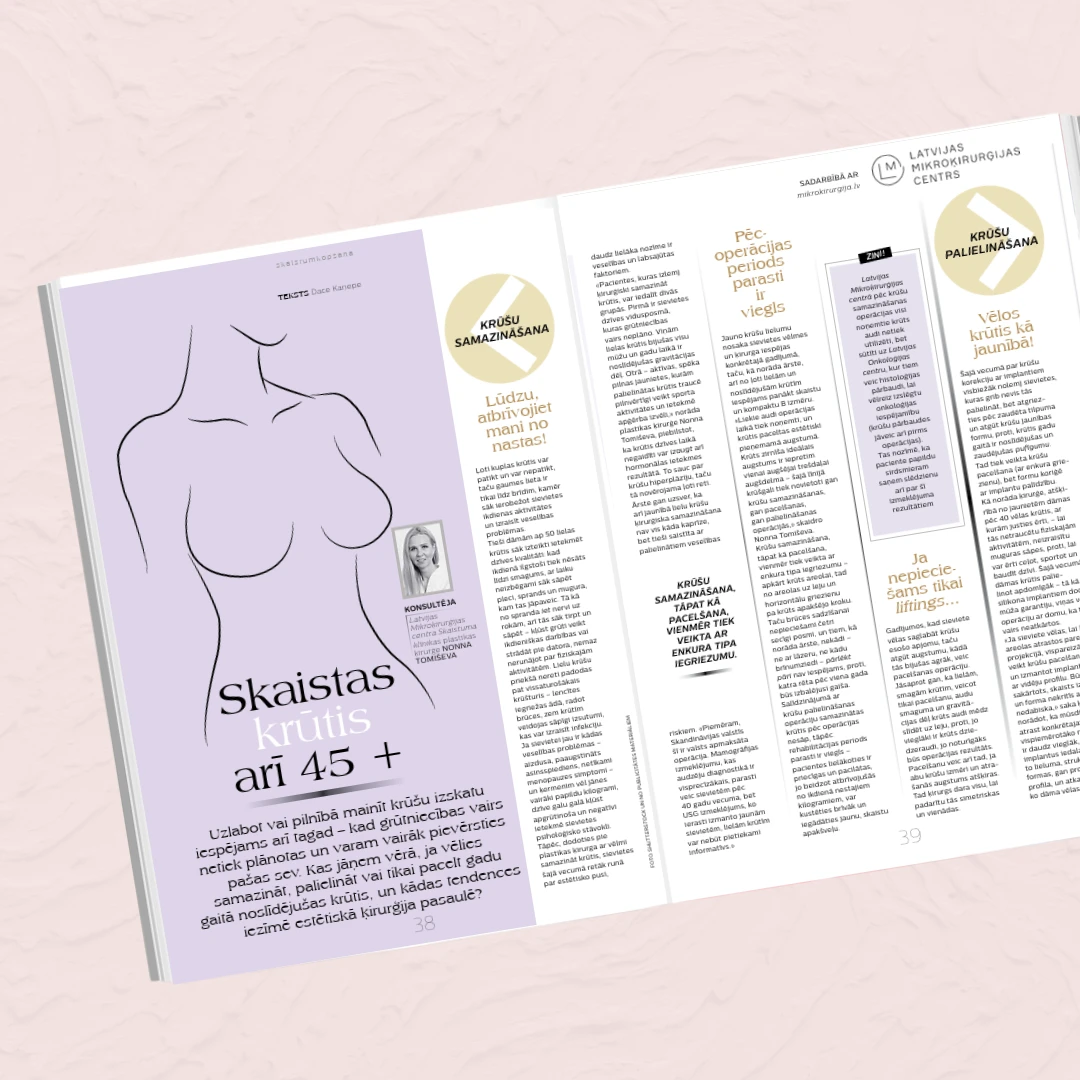
It’s possible to improve or completely change the appearance of your breasts now that you’re no longer planning to get pregnant and can focus more on yourself. What should you consider if you want to reduce, enlarge, or simply lift breasts that have sagged over the years, and what trends are emerging in cosmetic surgery worldwide?
CONSULTED BY NONNA TOMIŠEVA, a plastic surgeon at the Beauty Clinic of the Latvian Microsurgery Center.
Please relieve me of this burden!
Very large breasts may be attractive or unattractive, but it’s a matter of taste only until they begin to limit a woman’s daily activities and cause health problems.
It is precisely for women around age 50 that large breasts begin to significantly affect their quality of life: when this weight is carried around for long periods every day, over time the shoulders, neck, and back—which have to bear the load—inevitably begin to ache. Since nerves run from the neck to the arms, they, too, begin to tingle and ache—making it difficult to perform everyday tasks or work at a computer, not to mention engage in physical activities. Even the most supportive bra often fails when faced with large breasts—the straps dig into the skin, causing sores, and painful rashes form under the breasts, which can lead to infection. If a woman already has certain health issues—such as shortness of breath, high blood pressure, or unpleasant menopausal symptoms—and her body must also carry several extra kilograms, life ultimately becomes burdensome and negatively affects her psychological well-being. Therefore, when visiting a plastic surgeon with the desire to have a breast reduction, women of this age are less likely to focus on the aesthetic aspect; factors related to health and well-being are of much greater importance.
“Patients who decide to undergo breast reduction surgery can be divided into two groups. The first group consists of middle-aged women who no longer plan to become pregnant. They have had large breasts their entire lives, and over the years, they have sagged due to gravity. The second group consists of active, energetic young women for whom enlarged breasts interfere with their ability to fully participate in sports and limit their clothing choices,” notes plastic surgeon Nonna Tomiševa, adding that breasts can also grow unexpectedly over the course of a woman’s life as a result of hormonal influences. This is called breast hyperplasia, but it is observed very rarely.
The doctor emphasizes, however, that even at a young age, surgical reduction of large breasts is not merely a matter of personal preference, but is directly linked to increased health risks. “For example, in Scandinavian countries, this is a procedure covered by the government. Mammograms, which are the most accurate method for diagnosing tumors, are typically performed on women over the age of 40, but ultrasound, which is commonly used for younger women, may not provide sufficient information for women with large breasts.”
The size of the new breasts is determined by the woman’s preferences and the surgeon’s capabilities in each specific case, but, as the doctor points out, even very large and sagging breasts can be reshaped into a beautiful and compact B cup. “Excess tissue is removed during the surgery, and the breasts are lifted to an aesthetically acceptable height. The ideal height of the nipple is opposite the upper third of the upper arm; and the nipples are positioned along this line in breast reduction, lift, and augmentation surgeries,” explains Nonna Tomiševa.
Breast reduction, like a breast lift, is always performed using an anchor-shaped incision—around the areola, then downward from the areola, and a horizontal incision along the lower breast crease. However, wound healing requires four consecutive stages, and, as the doctor points out, it is impossible to skip any of them—neither with a laser nor with some miracle cure—meaning that each scar will have faded to a light color after one year.
Compared to breast augmentation surgery, breast reduction surgery does not cause pain after the procedure, so the recovery period is usually easy.Patients are mostly happy and elated because they’ve finally been freed from the extra weight they carried every day, can move more freely, and can buy new, beautiful lingerie.
GOOD TO KNOW! At the Latvian Microsurgery Center, after breast reduction surgery, none of the removed breast tissue is discarded; but is sent to the Latvian Oncology Center, where it undergoes histological examination to once again rule out the possibility of cancer (breast examinations must also be performed before surgery). This means that, for added peace of mind, the patient also receives the results of this examination.
In cases where a woman wishes to maintain her current breast size but restore them to their former height, a breast lift is performed. It’s important to understand, however, that with large, heavy breasts, a lift alone may not be sufficient—due to the weight of the tissue and the effects of gravity, the breast tissue tends to sag, namely, the lighter the breast tissue, the more durable the surgical result will be. A breast lift is also performed when the size and position of the two breasts differ. In such cases, the surgeon does everything possible to make them symmetrical and uniform.
I want breasts like I had when I was young!
At this age, the decision to undergo breast correction with implants is most often made by women who do not want to enlarge their breasts, but rather to restore lost volume and regain the youthful shape of their breasts, that is, over the years, their breasts have sagged and lost their “plumpness.” In such cases, a breast lift (using an anchor incision) is performed, and the shape is corrected with the help of implants. As the surgeon points out, unlike younger women, women over 40 want breasts that make them feel comfortable—breasts that do not interfere with physical activities or cause back pain, in other words, so they can travel comfortably, exercise, and enjoy life. At this age, women approach breast augmentation more thoughtfully. Since silicone implants come with a lifetime warranty, they undergo the surgery with the expectation that they won’t need to repeat it.
“If a woman wants her areolas to be in the correct position, the best approach is to perform a breast lift and use medium-profile implants. The result will be a harmonious, beautiful appearance, and the shape won’t look unnatural,” says the surgeon, noting that nowadays it is much easier to find the most suitable solution for a particular woman, since implants are classified not only by size, structure, and shape, but also by projection and profile, and depending on what the woman wants—a look that is as natural as possible or, conversely, a distinctly lifted appearance—the surgeon creates the desired shape and size of the breasts. The postoperative period is no different from what young women experience. A compression bra must be worn for about a month, until the swelling subsides and the breasts settle into place.”
Age 45 and older is also the time when women replace the implants they had inserted in their youth with new ones—most often smaller in volume and of medium profile—in combination with a breast lift.
“Ten or twenty years ago, everyone was afraid of anchor-shaped scars, and in fact, this method was used relatively rarely. That’s why even young women were advised to choose implants that were slightly larger than necessary. However, this choice has a downside: the larger the implants, the more the tissue will sag over the years. ”That’s why breast surgeons now tend to choose implants of the appropriate size and, if necessary, combine them with a lift,” the surgeon explains, outlining the latest trends.
Another trend is the so-called “yoga” or “ballerina” breasts. “It marks a clear shift toward a natural, small, youthful breast appearance and the methods used to achieve it,” explains Nonna Tomiševa. One of the key procedures associated with this trend is lipofilling, which, when performed correctly, results in a balanced, natural-looking bust. Lipofilling is used for breast augmentation and reshaping using the patient’s own fat, which is harvested, for example, from the abdominal area. Admittedly, it is not possible to enlarge the breasts to the same extent as with implants, but when combined with implants, it is possible to sculpt the breast shape in the desired direction. A potential drawback of lipofilling is that the injected fat eventually breaks down, forming calcifications in those areas. While these are harmless to health, they can be mistaken for tumor tissue during a breast examination; therefore, if you have undergone lipofilling in the breasts, you must inform your doctor of this before any breast examination. It is also important to know that lipofilling surgery will need to be repeated over time.
Hormonal fluctuations are not a contraindication for surgery. Even if you are going through menopause, the guidelines for the surgery are the same as when it is performed on a young woman with stable hormone levels.
Hormone-induced lymphostasis after the age of 45 can cause additional swelling, so you should pay close attention, first and foremost, to your diet. The biggest enemies are sugar and alcohol. Second, physical activity: the more physically active a woman is, the better the predicted outcome of the surgery.
The older the woman is, the more attention the doctor will pay to postoperative medication therapy.
Breast surgery can also be performed if you are still planning to become pregnant. However, it is never performed sooner than one year after the end of the breastfeeding period. That said, the long-term results of the surgery will be more predictable if it is performed after pregnancy is complete.
It is very important that the surgery be performed when the woman is at her ideal weight, because losing weight after the surgery is not a wise move.
When it comes to complications, smoking plays a much greater role than a woman’s age; moreover, it has finally been recognized that smoking regular cigarettes and vaping are equally harmful. If you’re planning to have breast surgery, it’s best to quit smoking well in advance.
Before surgery, it is also essential to stop taking the currently popular weight-loss medications. They have a very negative effect on tissue healing.
The skin must be clean before surgery: free of rashes, eruptions, infections, and skin diseases.
One of the questions women ask most often is, ”When will I be able to wear new, pretty lingerie?” You’ll have to wait a little while before you can wear lace. Since swelling will develop in the breasts after surgery, you’ll need to wear a special compression bra for at least a month to help the scars heal properly.
PRICES
Breast reduction – starting at 4,500 euros
Breast lift – starting at 3,800 euros
Breast lift with implants – starting at 4,800 euros
Breast augmentation with implants (without a lift) – starting at 4,000 euros
Women often ask whether the changes associated with menopause—which also affect skin quality—impact the outcome of the surgery. The doctor’s answer is that this factor requires additional attention (since better skin quality leads to a better healing process), but it is by no means a reason to forego surgery.
During the consultation, the plastic surgeon assesses the quality of the skin—for example, whether the woman has stretch marks left over from pregnancy, which indicate the quality of the collagen and elastin fibers. “If the skin isn’t radiant, I may recommend taking oral collagen before surgery. However, it’s important to understand that this doesn’t mean the collagen—no matter how advanced the chosen supplement may be—will actually reach the target tissues, because, as is well known, it’s a substance that is very poorly absorbed by the body,” notes the surgeon, adding that a radiofrequency procedure that stimulates connective tissue may prove useful; this can be performed on the décolletage area but not on the breasts themselves.
To sum up—for women who are in the habit of caring for their skin on a daily basis, the situation will certainly be more favorable than for those who have neglected it, and in fact, regularly using a moisturizer or even a special cream for the décolletage area is also the optimal routine for breast skin care, because, unlike the face—where various injections to improve skin quality can be administered before plastic surgery—nothing should be injected into the breasts.
‘Santa’ Magazine’