
LMC Media
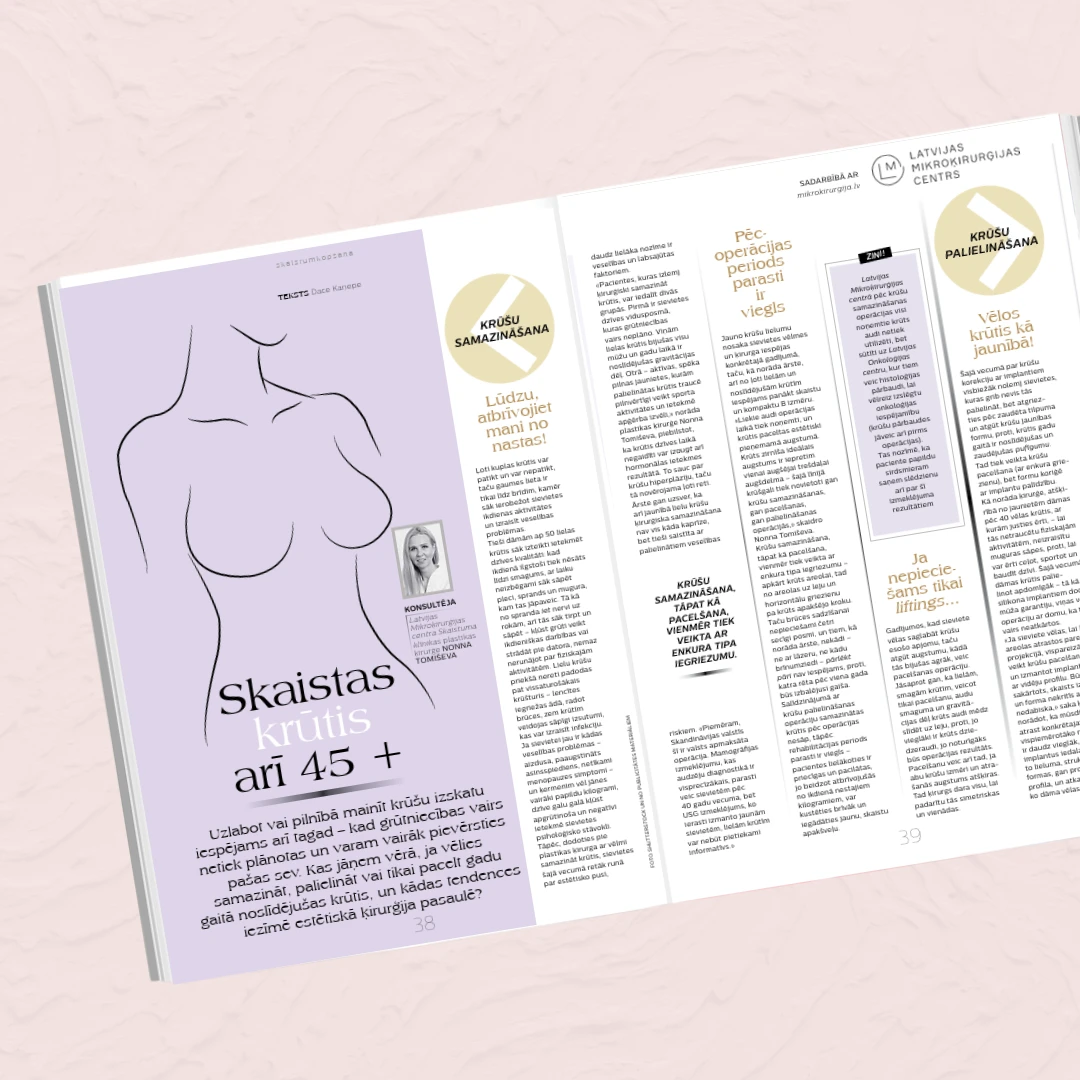
Beautiful Breasts Even After Age 45+
May 20, 2026

Ear deformities, defects, unusual shapes, sizes, damage, asymmetry, and other imperfections have often affected a person’s appearance and caused them considerable distress. The goal of otoplasty, or ear correction surgery, is to reshape the ear cartilage. This can be explained by people’s desire to look like others, rather than drawing unwanted attention to themselves with ears of a different shape. Differences in ear shape and deformities often cause not only aesthetic concerns but also psychological problems, especially during childhood.
Otoplasty is most commonly performed on children—it is a procedure to correct protruding ears. Children and parents prefer to have the surgery in the summer for several reasons—first, because of the long summer break, second, a child who has been worried about the problem returns to school and looks “as if nothing has changed,” so they don’t feel self-conscious about the changes. The recommended age is 9 years and older, as the ear cartilage is fully developed by this age.
– It is also possible to correct the shape of the ears (cup-shaped ears), congenital deformities of the auricle (absence of the auricle; small, drooping, twisted, flat, ingrown, or angular auricle; enlargement of the entire auricle or parts of it).
– Reconstructive surgeries are also performed following various injuries, such as the reattachment of torn earlobes, the auricle, etc.
– Recently, there has been an increase in plastic surgery to correct earlobes following the insertion of “tunnel” earrings. Young people are often unaware of the consequences; they hope they’ll be able to easily get rid of the „tunnels,” but that’s not the case! After wearing them for years, the hole becomes lined with skin, but the scar tissue stretches—and the hole remains.
First, it is important to understand that ear reshaping surgery does not affect hearing and that the results of the procedure are permanent. More than 200 otoplasty techniques are used in ear plastic surgery.
Doctors take all possible factors into account to ensure the patient’s comfort; therefore, to keep the scars from being noticeable, the incision is made behind the ear. A precise preoperative health assessment is very important—each ear is examined, measured, and photographed from the back of the head to rule out asymmetry.
The procedure typically lasts 1 to 3 hours under local anesthesia for older children and adults, and under a combination of local and general anesthesia for young children. An elastic postoperative bandage must be worn for 10–12 days after ear plastic surgery. It is recommended to wear it at night for up to 1 month. You can return to work or school after 5–7 days. For 1–2 months after otoplasty, you must wear an elastic bandage while playing sports.
Haralds Adovičs, board-certified plastic surgeon, microsurgeon, hand surgeon,
Anda Gaile, a board-certified plastic surgeon, microsurgeon, and hand surgeon,
Gundars Krauklis, board-certified plastic surgeon, microsurgeon, hand surgeon,
Māris Krūmiņš, a board-certified plastic surgeon,
Marta Taurīte, a board-certified plastic surgeon,
Nonna Tomisheva, a board-certified plastic surgeon, microsurgeon, and hand surgeon.