LMC Media
Beautiful Breasts Even After Age 45+
May 20, 2026
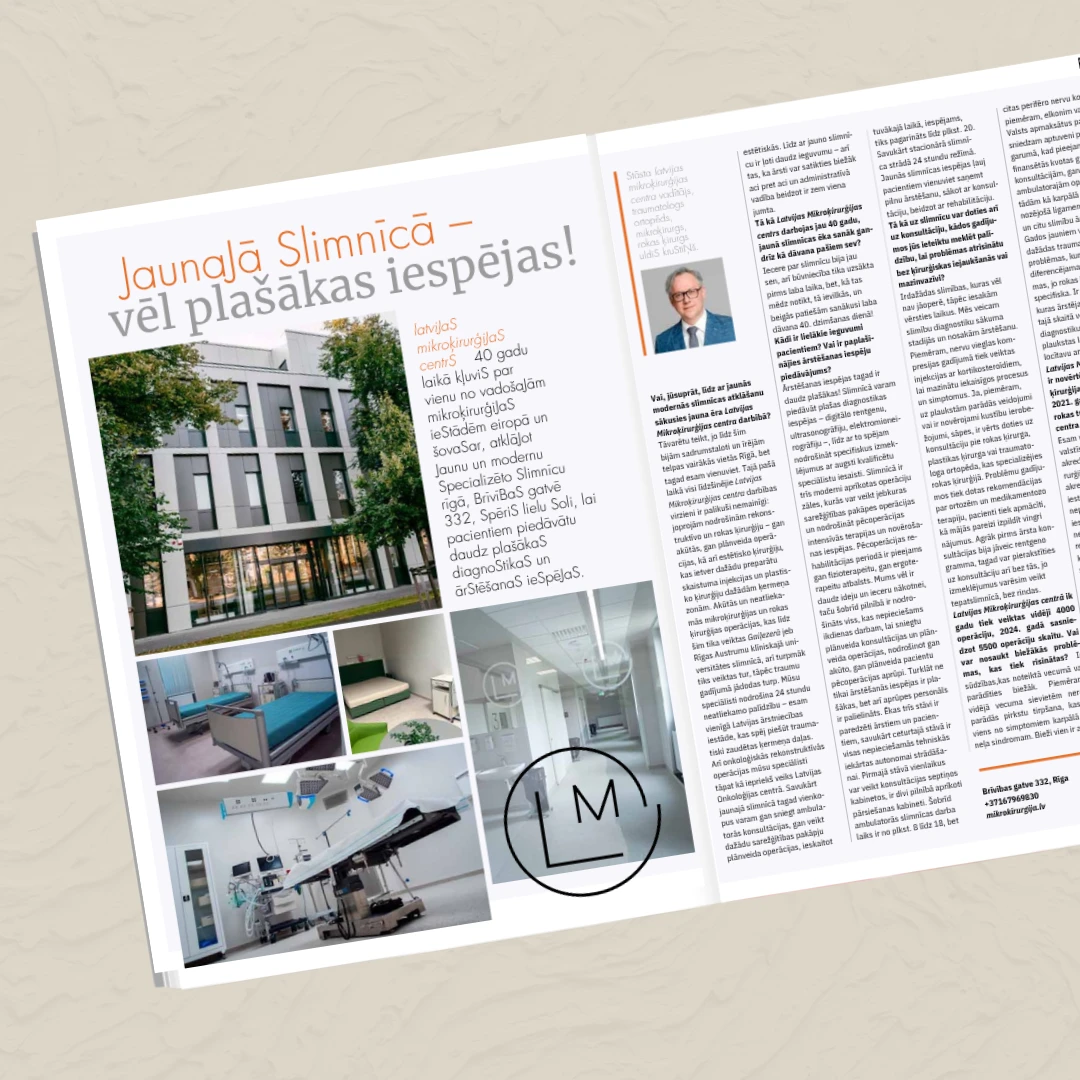
OVER THE PAST 40 YEARS, THE LATVIAN MICROSURGERY CENTER HAS BECOME ONE OF THE LEADING MICROSURGERY FACILITIES IN EUROPE, AND THIS SUMMER, WITH THE OPENING OF A NEW AND MODERN SPECIALIZED HOSPITAL IN RIGA, AT 332 BRĪVĪBAS STREET, IT HAS TAKEN A MAJOR STEP TOWARD OFFERING PATIENTS A MUCH WIDER RANGE OF DIAGNOSTIC AND TREATMENT OPTIONS.
This is according to ULDIS KRUSTIŅŠ, director of the Latvian Microsurgery Center, a traumatologist-orthopedist, microsurgeon, and hand surgeon.
– Do you think that the opening of the new, modern hospital marks the beginning of a new era for the Latvian Microsurgery Center?
– You could say that, because until now we were scattered and rented space in several locations in Riga, but now we’re all in one place. At the same time, all of the Latvian Microsurgery Center’s existing areas of practice have remained unchanged: we continue to provide reconstructive and hand surgery—both emergency and elective procedures— as well as aesthetic surgery, which includes beauty injections using various products and plastic surgery for different areas of the body. Acute and emergency microsurgery and hand surgery procedures, which until now have been performed at Gaiļezers, or Riga East University Hospital, will continue to be performed there, so in the event of an injury, you should go there. Our specialists provide 24-hour emergency care—we are the only medical facility in Latvia capable of reattaching body parts lost due to trauma. Our specialists will also continue to perform oncological reconstructive surgeries at the Latvian Oncology Center, just as before. Meanwhile, at the new hospital, we can now provide both outpatient consultations and perform elective surgeries of varying complexity—including cosmetic procedures—all under one roof. The new hospital brings many benefits—including the fact that doctors can meet face-to-face more often and that administrative management is finally under one roof.
– Since the Latvian Microsurgery Center has been in operation for 40 years now, is the new hospital building almost like a gift to yourselves?
– The idea for the hospital had been around for a long time, and construction had begun quite a while ago, but, as often happens, it dragged on, and in the end, it really turned out to be a great gift for my 40th birthday.
– What are the main benefits for patients? Has the range of treatment options expanded?
– Treatment options are now much more extensive! At the hospital, we offer a wide range of diagnostic services—including digital X-rays, ultrasound, and electromyography—which allows us to provide specialized examinations with the involvement of highly qualified specialists. The hospital has three state-of-the-art operating rooms capable of performing surgeries of any complexity and providing postoperative intensive care and monitoring. During the postoperative rehabilitation period, support from both physical therapists and occupational therapists is available. We still have many ideas and plans for the future, but at present, everything necessary for our daily operations is fully in place to provide scheduled consultations and elective surgeries, ensuring postoperative care for both acute and elective patients. Furthermore, not only are treatment options more extensive, but the number of care staff has also increased. The building’s three floors are designated for doctors and patients, while the fourth floor houses all the technical equipment necessary for autonomous operation. On the first floor, consultations can be conducted simultaneously in seven examination rooms, and there are two fully equipped dressing rooms. Currently, the outpatient clinic’s hours are from 8:00 a.m. to 6:00 p.m., but they may soon be extended to 8:00 p.m. The inpatient hospital, meanwhile, operates 24 hours a day. The new hospital’s facilities allow patients to receive comprehensive care in one location, from initial consultation through rehabilitation.
– Since you can also go to the hospital for a consultation, in what situations would you recommend seeking help to resolve problems without surgery or through minimally invasive procedures?
– There are various conditions that do not yet require surgery, so we recommend seeking treatment early. We diagnose conditions in their early stages and determine the appropriate treatment. For example, in cases of mild nerve compression, we administer corticosteroid injections to reduce inflammation and alleviate symptoms. If, for example, lumps appear on the hands or there are noticeable limitations in movement, or pain, it is advisable to consult a hand surgeon, plastic surgeon, or orthopedic traumatologist who specializes in hand surgery. In cases of problems, recommendations are provided regarding orthoses and medication therapy, and patients are instructed on how to properly perform exercises at home. Previously, an X-ray was required before a doctor’s consultation; now you can schedule a consultation even without one, as we can perform the examinations right here at the hospital, without waiting in line.
– An average of 4,000 surgeries are performed each year at the Latvian Microsurgery Center, with the number reaching 5,500 in 2024. Can you name the most common issues that are addressed there?
– There are certain complaints that may occur more frequently at a certain age. For example, middle-aged women often experience numbness in their fingers, which is one of the symptoms of carpal tunnel syndrome. There are also often other cases of peripheral nerve compression, such as in the elbow or neck. We provide state-funded services for approximately half a year, when quotas funded by the National Health Service (NVD) are available for both patient consultations and minor outpatient surgeries, such as treatment for carpal tunnel syndrome, stenosing ligamentitis, Dupuytren’s contracture, and other conditions. Young men may experience various traumatic hand problems that are difficult to differentiate or diagnose elsewhere, as hand surgery is quite specialized. There are many conditions that only we treat, including performing arthroscopic diagnostics and surgeries—such as those on the wrist joint and the joints of the small bones.
– The Latvian Microsurgery Center has also been recognized by the European Federation of Hand Surgery Associations, which awarded it the prestigious status of a hand trauma and replantation center in 2021.
– We are the only center in the Baltic States to have received this accreditation. The European Federation of Hand Surgery Associations grants this accreditation to medical institutions that meet all the necessary criteria, including the provision of continuous and specialized reconstructive and microsurgical care 24 hours a day, seven days a week.
– What are the most common injuries during the cold season?
– Spring is often the season with the most injuries, when saws are pulled out of storage again and activity in the gardens picks up, but, as we know, repairs are carried out year-round, so tool-related injuries occur in all seasons. As the New Year approaches, injuries caused by fireworks become more common, so we need to be careful.
Magazine: “Ieva’s Health”