LMC Media
Beautiful Breasts Even After Age 45+
May 20, 2026


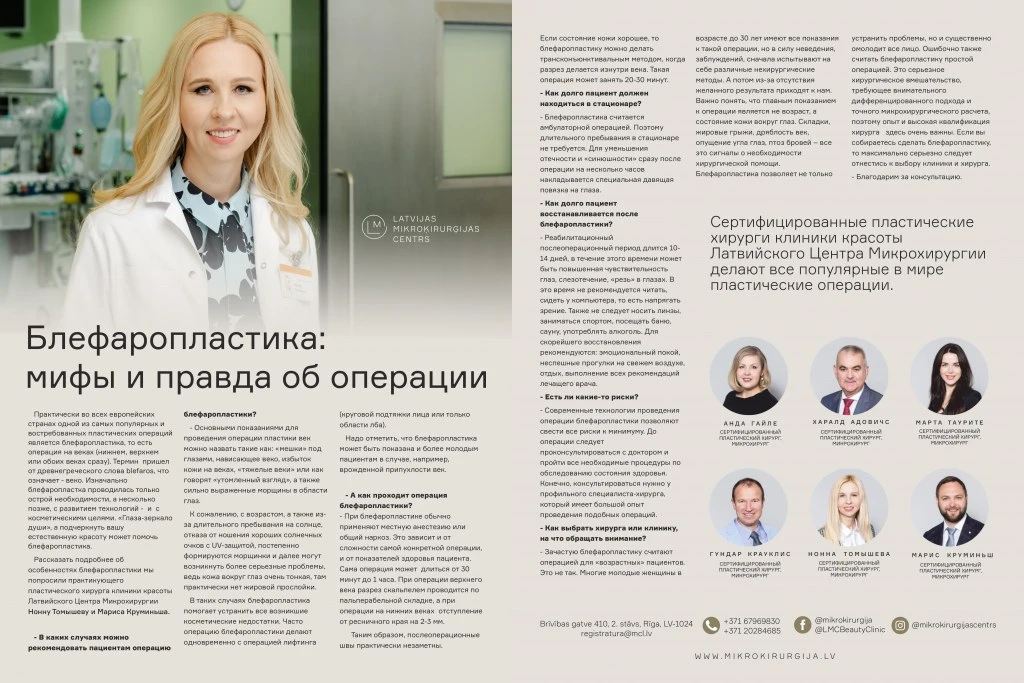
In almost all European countries, one of the most popular and in-demand plastic surgery procedures is blepharoplasty—that is, surgery on the eyelids (lower, upper, or both at once). The term derives from the Ancient Greek word blepharos, which means “eyelid.” Initially, blepharoplasty was performed only in emergency cases, and somewhat later, as technology advanced, for cosmetic purposes. “The eyes are the window to the soul,” and blepharoplasty can help accentuate your natural beauty. .
We asked Nonna Tomiševa and Māris Krūmiņš, practicing plastic surgeons at the Beauty Clinic of the Latvian Microsurgery Center, to tell us about the specifics of blepharoplasty. .
– In what cases might blepharoplasty be recommended for patients?
– The main indications for eyelid surgery include: “bags” under the eyes, drooping eyelids, excess skin on the eyelids, “heavy eyelids” or, as they say, a “tired look,” as well as pronounced wrinkles around the eyes.
Unfortunately, with age—as well as prolonged exposure to the sun and a failure to wear good sunglasses with UV protection—fine lines gradually form, and more serious problems may arise, because the skin around the eyes is very thin and has practically no fat layer.
In such cases, blepharoplasty helps correct any cosmetic imperfections that have developed. Blepharoplasty is often performed in conjunction with a facelift (a full facelift or just the forehead area).
It should be noted that blepharoplasty may also be indicated for younger patients, for example, in cases of congenital eyelid swelling.
How is blepharoplasty performed?
– Blepharoplasty is usually performed under local or general anesthesia. This depends on the complexity of the specific procedure and the patient’s health status. The procedure itself can last from 30 minutes to 1 hour. During upper eyelid surgery, an incision is made with a scalpel along the natural crease, and during lower eyelid surgery, the incision is made 2–3 mm from the ciliary margin.
As a result, the postoperative sutures are almost invisible.
If the skin is in good condition, blepharoplasty can be performed using the transconjunctival approach, in which the incision is made on the inner side of the eyelid. This procedure can take 20–30 minutes.
– How long does the patient need to stay in the hospital?
– Blepharoplasty is considered an outpatient procedure. Therefore, a prolonged hospital stay is not necessary. To reduce swelling and “cyanosis,” a special compressive bandage is applied to the eyes for several hours immediately after surgery.
– How long does it take for a patient to recover after blepharoplasty?
– The postoperative recovery period lasts 10–14 days; during this time, you may experience increased eye sensitivity, tearing, and a “stinging” sensation in the eyes. During this time, it is not recommended to read, use a computer, or otherwise strain your eyes. You should also avoid wearing contact lenses, exercising, taking baths or saunas, and consuming alcohol. For a speedy recovery, we recommend: emotional calm, leisurely walks in the fresh air, rest, and following all of your doctor’s recommendations.
– Are there any risks?
– Modern blepharoplasty techniques help minimize all risks. Before the surgery, you should consult with a doctor and undergo all necessary tests to assess your health. Of course, you should consult with a specialized surgeon who has extensive experience performing these types of surgeries.
– How do you choose a surgeon or clinic? What should you look for?
– Blepharoplasty is often considered a procedure for “older” patients. That’s not true. Many young women under the age of 30 meet all the criteria for this procedure, but due to a lack of knowledge or misconceptions, they first try various non-surgical methods. And then, because they don’t achieve the desired results, they come to us. It’s important to understand that the main indication for surgery is not age, but rather the condition of the skin around the eyes. Wrinkles, fat herniation, drooping eyelids, sagging of the outer corners of the eyes, and eyebrow ptosis are all signs that surgical intervention is necessary. Blepharoplasty not only corrects these issues but also significantly rejuvenates the entire face. It is also a mistake to view blepharoplasty as a simple procedure. It is a serious surgical procedure that requires a careful, individualized approach and precise microsurgical technique; therefore, the surgeon’s experience and high level of qualification are crucial. If you are planning to undergo blepharoplasty, you should take the choice of clinic and surgeon as seriously as possible.
– Thanks for the advice.
Certified plastic surgeons at the Latvian Microsurgery Center's cosmetic surgery clinic perform all of the most popular plastic surgery procedures worldwide.
Contacts:
410 Brīvības gatve, 2nd Floor, Riga, LV-1024
To schedule a consultation:
(+371) 679 698 30, (+371) 202 846 85